
Resistance, Re-Imagine
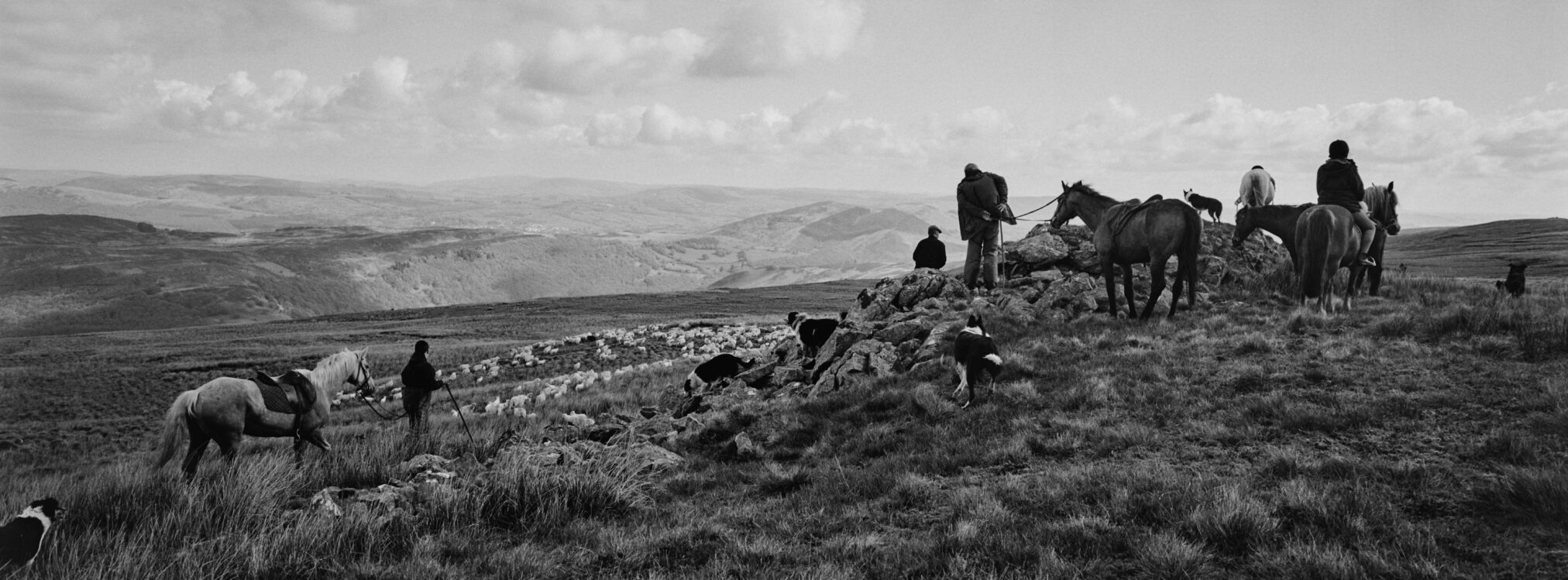
Resistance, Re-Imagine by Zillah Bowes and Turjo Mushfiq brings together two bodies of work created 5,000 miles apart. Bowes’ Open Hill explores landscapes impacted by sheep farming, historic flooding and climate change in the Elan and Claerwen Valleys in Mid Wales, UK, alongside tenant farmers who maintain traditional working methods and gather sheep communally. Mushfiq’s Living Ruins observes Dhaka, Bangladesh, a city overwhelmed by concrete and overcrowding. He seeks out pockets of nature and communities finding space for wellbeing within them.
Working with a Hasselblad XPan, Bowes creates panoramas whose edges, as she describes, hold both ‘conclusion and movement.’ Through meticulous compositions, she photographs human collaborators and landscape with equal attention, rendering each sometimes small, sometimes dominant in the frame. Our eyes are compelled to travel, as if following water, a theme running through both works.
Mushfiq describes a flowing river of concrete that prompts inhabitants to move on. When he returns to meet his collaborators, they are gone. Working with paper negatives in a traditional box camera, he produces beautiful, disorienting images in which people and fragments of nature emerge from the concrete. Distortions make the city appear to move, folding in on itself, ungraspable.
These analogue cameras invite sustained observation, encouraging both artists to attend to everyone and everything in the frame. Against the relentless scroll of news footage documenting climate emergencies, Bowes and Mushfiq offer a slower form of looking, asking us to recognise each person, animal and landscape as distinct yet deeply connected.
Exhibited concurrently at MAC Birmingham and Pathshala Institute in Bangladesh, these works bring distant landscapes into dialogue. Together, they make visible the unravelling of ecological systems and the urgency of these changes. Their proximity allows connections to emerge that might otherwise remain unseen, revealing how environmental changes in seemingly disparate places are part of a shared, interconnected reality.
Like a mycelial network, this collaboration creates space for exchange, nurturing understanding across distances and communities. In uniting these works, the artists demonstrate photography’s capacity to deepen our relationship with the land and its communities, make environmental change tangible, and open possibilities for collective response.
Clare Hewitt
Artist, Archivist and Educator